How to Choose a Pet Name: 7 Simple Rules That Stick
Simple rules for how to choose a pet name your dog or cat can actually learn.

How to choose a pet name is a training problem first and a Pinterest problem second. A name that looks cute on a collar tag can still sound like “sit,” vanish in a windy park, or clash with your other dog’s name. Dogs and cats learn sounds through repetition and happy outcomes. Your job is to pick a sound that is easy to hear, hard to confuse, and kind to shout across a lifetime of vet visits.
In my research I found the same patterns in guides from the AKC, ASPCA Pet Insurance, and VCA: prefer short names, avoid command soundalikes, test aloud, allow a trial period, and teach the name with positive association. A useful tip from AKC’s teach-name guidance is to treat the name as an attention cue that predicts good things, not as a scolding opener.
This post stays criteria-first. Short examples illustrate rules. Free RandomGens pet, dog, cat, and animal tools expand volume after your filters exist. I am a site author writing for households, not a veterinary behaviorist. Animals vary. Seek a qualified trainer or vet behaviorist when you need personalized help.
How to choose a pet name for real-life use
Calling, training, vet visits, and family chatter
List the real contexts:
- Calling them off a smell in the yard
- Name-as-attention cue before a cue like “come”
- Reading the name aloud in a busy vet waiting room
- Relatives who will babysit and must pronounce it the same way
If a name only works as a silent Instagram caption, it fails the job.
Why “clever for a week” often fails
Long fantasy spellings, four-syllable joke names, and names that rhyme with “no” feel funny until you are late for a walk. Clever decays. Usable lasts. Keep one joke nickname for the living room if you want. Keep the official call-name simple.
Sound rules that help dogs and cats learn
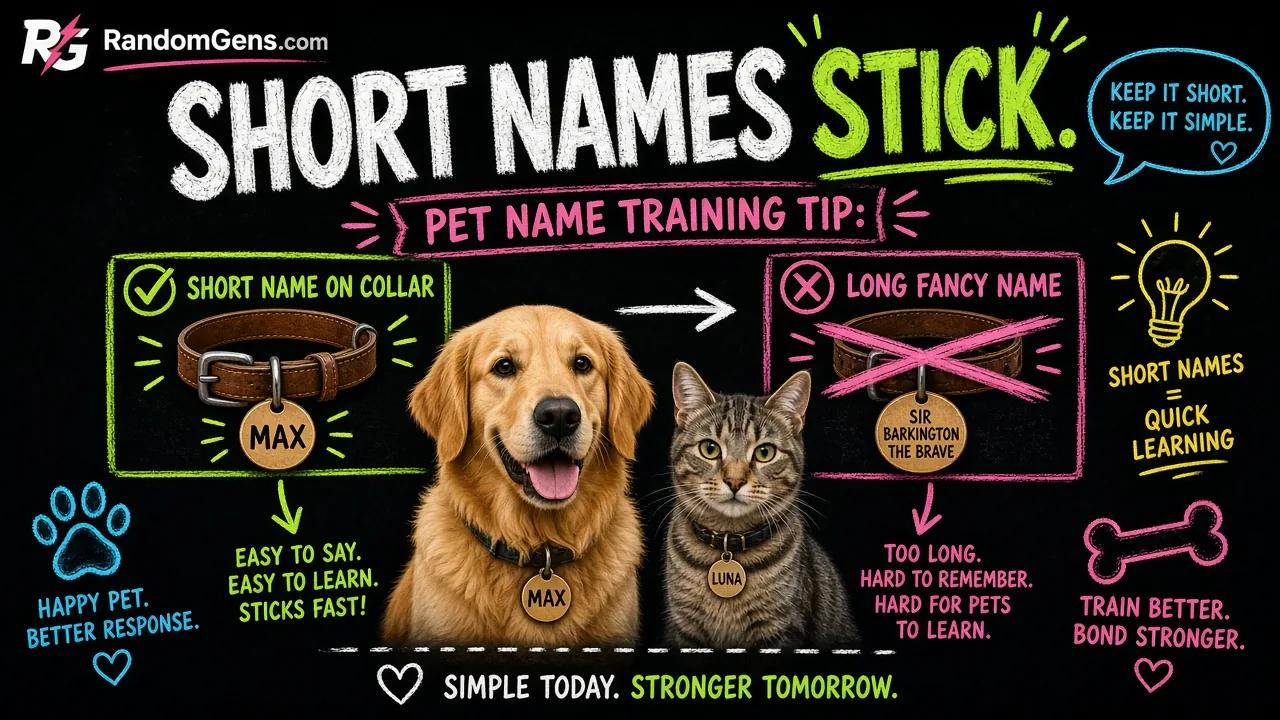
Keep it short (usually one or two syllables)
AKC and many trainer-facing tips favor shorter names so the animal can catch the sound quickly. “Max,” “Luna,” “Bean,” “Koji” clear faster than “Bartholomew the Brave.” You can still have a fancy registered name for papers. The daily call-name should be short.
Prefer distinct, easy-to-hear sounds
Harder consonants and clear endings often cut through noise better than soft mush. That does not mean every pet must be named “Kip.” It means test the name at distance and in wind, not only whispered on the couch.
Ending sounds matter too. Names that trail off into a quiet vowel can disappear outdoors. Try the same name with a slightly brighter ending if needed.
Avoid names that rhyme with sit, stay, no, or come
This is one of the highest-value filters and one of the most ignored.
Risky neighborhood (illustrative, not a ban list):
- Kit / Sit
- Faye / Stay
- Bo / No
- Rum / Come
- Bea / Pee (housetraining chaos)
If your main recall cue is “come” and your dog is named something that collapses into the same mouth shape, you will train two meanings onto one blur. Pick a different sound.
Fit the animal without boxing them in
Personality and energy (with room to grow)
A sleepy rescue may become a maniac after three months of good food and confidence. Avoid names that lock a temporary mood (“Chaos,” “Grumpy”) unless you are truly fine shouting them at the park forever. Personality cues are optional hints, not destiny.
Appearance and breed heritage as optional cues
Color and breed history can inspire (“Ash,” “Shepherd-adjacent nods,” coat textures) without becoming a stereotype trap. If the only idea you have is the coat color, keep brainstorming.
Cat vs dog quirks (tone and ending sounds)
Dogs often hear their names in outdoor recall contexts. Cats often hear theirs in indoor cue and meal contexts. Cats can learn names too; ASPCA Pet Insurance and other consumer resources discuss that pets can learn to respond when the sound predicts good things. For cats, sharp short names still help, and consistency across the household matters as much as cleverness.
Tone matters for both: happy name, happy outcome. Do not use the call-name only when you are angry.
Household and multi-pet checks
Not too close to people names or other pets
If your partner is “Jenna” and the puppy is “Jenna,” dinner gets weird. If dog A is “Milo” and dog B is “Nilo,” you will misfire cues. Keep distinctive first syllables across the household roster, including humans and pets.
Everyone can pronounce it the same way
Write the name. Ask each household member to say it. If one person softens a consonant and another hardens it, pick a simpler option. Consistency is part of the cue.
The real-life tests before you commit
Shout test and distance test
Stand across the yard or down a hallway. Shout the candidate name once, in a normal happy tone. Does it punch through? Does it feel embarrassing in a way that will make you hesitate later? Hesitation matters. You need a name you will actually use at full volume.
Vet waiting-room test
Imagine reading it to a receptionist. Names with joke spellings (“Myxxxy”) become support tickets. Names that sound like medical instructions get mis-heard. Choose something a stranger can type.
48-hour trial with consistent use
Many guides (Hill’s among them) suggest a trial period. Use one candidate consistently for a day or two with treats and happy tone. If the whole household hates saying it, or it keeps colliding with cues, swap before ID tags and paperwork harden the choice.
Rescues and renaming
When keeping the old name is kinder
If a rescue already knows a name and responds to it, keeping it can reduce stress and speed bonding. Ego renames are optional. Training continuity is not vanity.
How to change a name without confusing them
If the old name is a command clash, offensive, or unused, you can change it:
- Pick the new short name using the rules above
- Pair the new name with treats and play for several short sessions a day
- Optionally say old-name then new-name during transition, then fade the old name
- Make sure every human uses the same new sound
Patience beats scolding. The name should predict good things.
Build a shortlist (then expand with tools)
Classic, nature, food, storybook, and wildlife themes
Build 10-15 candidates across themes so you are not stuck in one vibe:
- Classic: short timeless sounds
- Nature: rivers, trees, weather (still run the command filter)
- Food: fine if it survives the shout test
- Storybook: characters you will not get tired of
- Wildlife: species-inspired themes for flavor
Illustrative shortlists (not “the” names, just rule demos):
Dog call-name demos that clear basic filters: Nova, Scout, Remy, Peg, Zito Cat call-name demos: Miso, Pip, Cinder, Juniper (three syllables: optional indoor-only), Tad Reject demos and why: Kit (sit), Bo (no), Faye (stay)
Your taste can differ. The filters should not.
Free RandomGens pet, dog, cat, and animal generators
After your rules exist, generate volume:
- Random pet name generator for mixed household brainstorming
- Random dog name generator when the learner is a dog
- Random cat name generator when the learner is a cat
- Random animal generator for wildlife-theme inspiration (use the animal idea as a spark, then shorten into a call-name)
Honest limit: these tools do not know your cue set, your other pets’ names, or your vet’s accent. Paste candidates into your checklist. Cut hard. This post will not dump hundreds of names as main content on purpose.
Teach the name after you choose
Happy tone, rewards, never use the name only for scolding
AKC’s guidance on teaching a dog their name matches good practice for many households: say the name, mark attention, reward. Keep sessions short. If the name only appears before nail trims and scoldings, you poison the cue.
Cats benefit from the same contingency: name predicts meal, play, or gentle attention. Individual animals differ. If fear or aggression shows up, get professional help rather than repeating louder.
What “learned the name” looks like in practice
A pet that knows their name usually orient toward you when you say it in a normal tone, especially when the sound has predicted food, play, or affection. That is attention, not mind reading. AKC’s teach-name guidance for dogs is a useful pattern: say the name, mark the look or approach, reward, repeat in short bursts. Generalize gradually to mild distractions.
Household script that keeps cues clean:
- One person says the name once (not a chant)
- The moment the animal looks or steps toward them, mark and reward
- Other humans use the identical pronunciation
- Never stack the name as punishment (“Peg! Peg! PEG!”) before a scolding
If two pets both look when one name is said, your sounds are too close. Rename or retrain with more contrast.
Short example shortlists (illustrative, not the whole post)
Use these as pattern checks, then build your own:
| Candidate | Syllables | Command clash risk | Notes |
|---|---|---|---|
| Peg | 1 | Low | Sharp, easy to shout |
| Remy | 2 | Low | Clear ending |
| Miso | 2 | Low | Fun food theme that still hears clean |
| Kit | 1 | High vs sit | Reject or change cues |
| Bo | 1 | High vs no | Reject |
When your table has 5-8 survivors, run the shout, vet, and 48-hour tests. Then commit.
Sources and further reading
- AKC: Choose your dog’s name
- AKC: How to teach a dog their name
- ASPCA Pet Insurance: How to pick a pet name
- VCA: Tips for choosing a new pet’s name
- Hill’s: Perfect pet name guide
- Dogster: How to choose a dog name
Training outcomes vary by animal, history, and household. This is general consumer guidance, not a behavior diagnosis. For RandomGens tool help: support@randomgens.com.