How to Name a Business: 6 Proven Easy Pre-File Checks
A practical checklist for how to name a business before you spend money on filings.
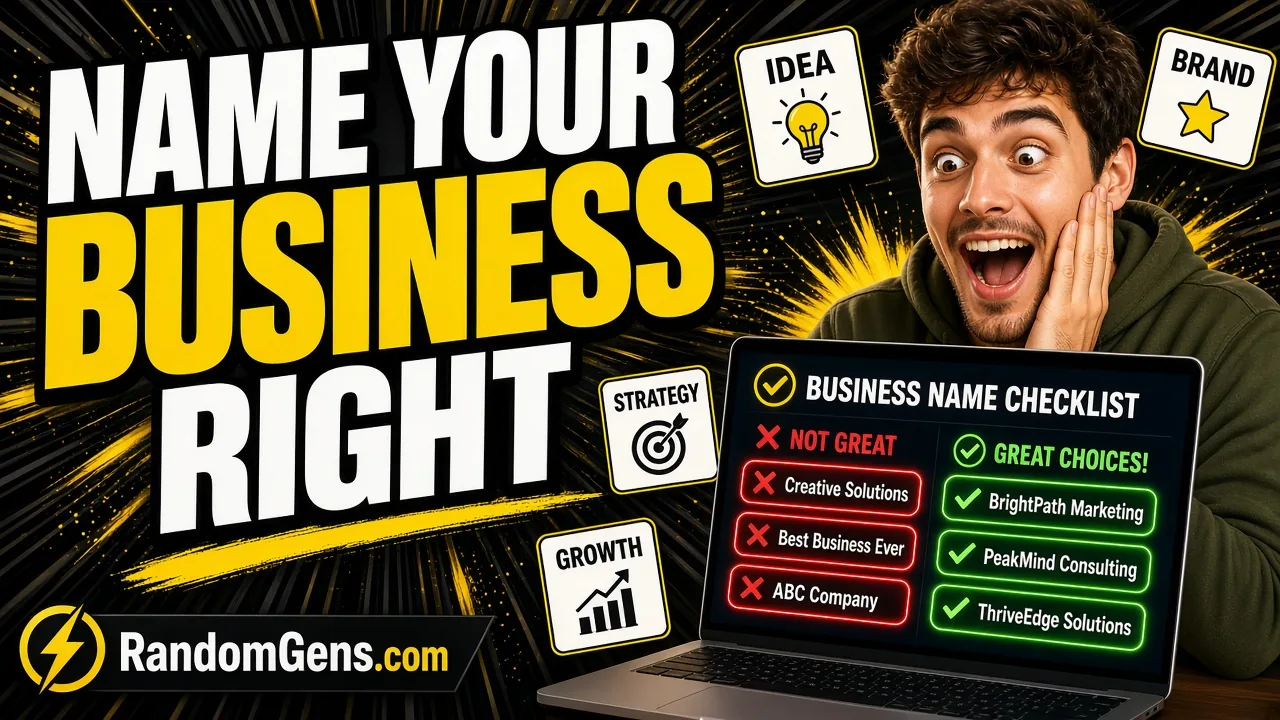
How to name a business is less about finding one “perfect” word and more about surviving the screens that come after the brainstorm. A name that sounds great in your head can still fail a phone test, collide with a trademark, or leave you with a domain you cannot buy.
In my research I found the same practical advice showing up again and again from the SBA guide on choosing and protecting a name and the USPTO federal trademark searching pages: keep it sayable, check availability across surfaces, and do not box yourself into one product forever. A useful tip from Stripe’s overview of checking if a business name is taken is to treat domains, handles, entity filings, and trademarks as separate checkboxes, not one Google search.
Generators create volume. You decide. I am the RandomGens site author, not a trademark attorney. Nothing here is legal advice.
How to name a business that survives real checks
Easy to say, spell, and remember
If a stranger cannot spell it after hearing it once, you will spend forever correcting emails and invoices. Say the name out loud. Spell it over an imaginary phone call. Ask one friend to type it without seeing it written. Hard spellings and silent letters feel clever for a week and expensive for years.
Fits today without trapping tomorrow
“Austin Bike Repair North” is clear for a local shop. It is awkward if you add scooter rentals, open a second city, or sell online kits. Descriptive names win early clarity. Broader or invented names win room to grow. Pick the tradeoff on purpose.
Available enough across the surfaces that matter
A name is not “available” because your group chat likes it. You care about some mix of:
- State or local entity name rules where you will form the business
- Assumed name / DBA rules if you trade under a different public name
- Domain and priority social handles
- Trademark look-ups for confusingly similar marks in related goods/services
The SBA guide separates these layers better than most blog posts. Treat them as different checkboxes.
Pick a naming style before you brainstorm
Descriptive (clear for local services)
Examples in spirit: “Cedar Plumbing,” “Night Owl Bookkeeping.” Customers understand the offer. Marketing can be simpler. The risk is sameness and a tighter future box.
Invented or suggestive (more brandable, more marketing work)
Made-up or suggestive names can be easier to trademark in some cases and easier to own as a .com story, but you must teach people what you do. Budget time for that education.
Founder or partnership names (trust vs flexibility)
Using your surname can signal trust for consulting or professional services. It can also complicate co-founders, exits, and sale of the business later. Decide with your eyes open.
You do not need a fancy taxonomy. You need a style choice so your shortlist is comparable.
Build a shortlist fast (without falling in love too early)
Word bank from offer, audience, and values
Write three columns: what you sell, who you serve, how you want to feel (calm, fast, premium, playful). Pull 20-40 raw words. Do not judge yet.
Letter and syllable constraints
Decide early: one word or two? Max syllables? Any letters you refuse because they are hard to hear on a call (often soft pairs like “s” vs “f” in noisy rooms)? Constraints cut noise.
Use generators for volume, then cut hard
When your word bank stalls, use free brainstorm tools for volume only:
- Random team name generator for punchy two-part and group-style names (useful for startups, clubs, and side projects; not every team name is a federal trademark)
- Random word generator for fresh stems and unexpected pairings
- Random letter generator when you want acronym seeds or constrained initials
Honest limit: RandomGens will not check trademarks, register your LLC, or vouch that a name is “clear.” It throws options. You run the checklist below and discard most of them on purpose.
Aim for a shortlist of 8-12 candidates before deep screening. Falling in love with one unscreened favorite is how people waste weeks.
The screening checklist (do this in order)
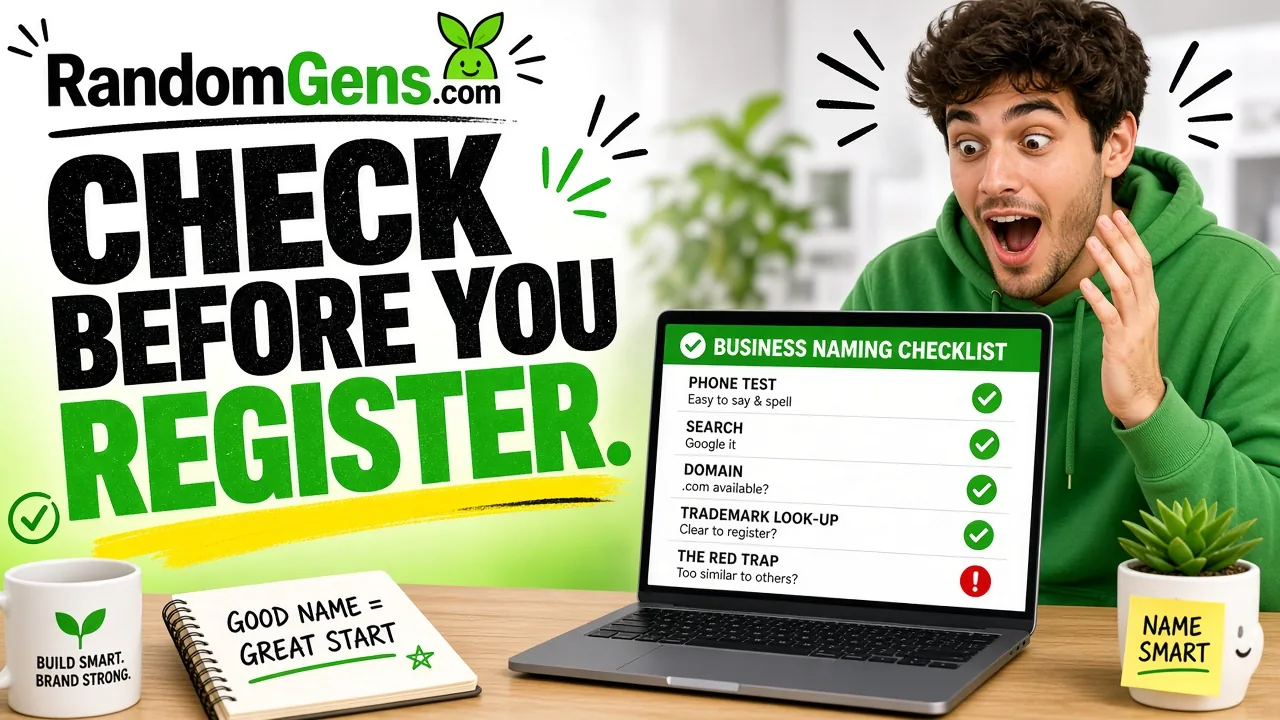
Do these steps in order. Skipping ahead to logo mockups is how bad names get expensive.
1. Phone and shout test
Call a friend. Say only the name. Ask them to spell it back and say what kind of business they imagine. If they stumble, next candidate.
Also shout it across a room. Names that collapse into mush at distance fail customer service and busy markets.
2. Broad web search + industry search
Search the exact name, then the name plus your category, then common misspellings. Look for:
- Existing companies in your space
- Scandal or spam associations you do not want
- Very famous marks you would rather not sit next to
I came across an interesting point from Stripe’s business name availability overview: people forget whole surfaces (handles, DBAs, lookalike domains) because they only checked one registrar search.
3. Domain and priority social handles
Check the .com (or the TLD your market actually uses) and the handles you care about (often Instagram, TikTok, X, LinkedIn, YouTube depending on the business). Exact-match everywhere is nice. Consistent-enough is often enough. Decide your “must match” list before you compromise.
If the perfect .com is taken by a parked page, price that problem into the decision. Do not assume you will “figure it out later.”
4. State / entity name check (where you will form)
Entity name rules vary by place. Use the official business search for the state or country where you will form the company. The SBA page links the protection layers at a high level; your local filing office has the final say on entity-name conflicts.
Remember: clearing an entity name is not the same as owning a trademark nationwide.
5. Trademark look-up (research, not legal advice)
For US-focused readers, start with the USPTO’s guidance on federal trademark searching. Search for identical and confusingly similar marks in related goods and services.
This is a research screen so you do not ignore obvious collisions. It is not a clearance opinion. If the name matters and the risk is real, talk to a qualified trademark professional. Rules differ outside the US.
6. Language and accidental meaning check
Ask native speakers if you sell across languages or regions. Check slang. Read the name fast and slow. Look at the acronym. A funny private joke that reads as an insult in another market is not clever branding.
Optional after a shortlist survives: style a bio or handle microcopy with the tiny text generator if you want decorative social text. That is polish, not a naming decision.
Entity name vs DBA vs trademark vs domain (plain English)
People mash these words together. Keep them separate:
- Entity name: the legal name you register when you form an LLC, corporation, or similar (rules are local)
- DBA / assumed name / trade name: the public name you operate under if it differs from the entity name (filing rules vary)
- Trademark: rights tied to use in commerce for specific goods/services; federal registration is a separate path (USPTO in the US)
- Domain / handles: technical addresses and social usernames you control through registrars and platforms
Clearing one layer does not clear the others. That is the whole point of an ordered checklist.
Common traps that waste weeks
Hard spellings and forced cleverness
Dropped vowels, random “xy,” and silent letters look modern in a mockup and fail in voice search, radio ads, and support calls.
Names that clash with commands or confuse teams
Internal code names that sound like product features, or names your team cannot pronounce the same way, create daily friction. If two cofounders stress different syllables, customers will too.
Falling in love before availability checks
Logo first is a trap. Screen first. Design second. The checklist exists so affection happens after survival.
From shortlist to decision
Test on a mock invoice, email, and homepage H1
Put the finalists on:
- A fake invoice (“Thanks for paying Cedar Ledger”)
- An email from address style
- A homepage H1 and a one-line tagline
If it feels wrong in those three places, it will feel wrong in the wild.
Worked (fictional) example for the method, not a recommendation:
- Style choice: suggestive, two syllables max, not geography-locked
- Word bank survivors: “Harbor,” “Ledger,” “Northlane,” “Brightcoil”
- Phone test kills “Brightcoil” (people hear “Bright Call”)
- Web + industry search kills “Harbor” in your category
- Domain/handles: “Northlane” is messy; “Ledger” variants conflict
- You keep a new pairing from the word generator loop, run state search + USPTO look-up as research, language check passes
- Mock invoice and H1 feel clean, so you reserve domain/handles and talk to a professional about filings
That is the shape. Your words will differ. The order should not.
Reserve what you can once you choose
When one name survives, move: domain, critical handles, and whatever entity or DBA steps your jurisdiction requires. Do not announce a big brand launch on a name you have not reserved.
Free RandomGens tools for brainstorm loops
Use these when you need more raw clay, then return to the checklist:
- Random team name generator
- Random word generator
- Random letter generator
- Optional polish: tiny text generator
Sources and further reading
- SBA: Choose your business name
- USPTO: Federal trademark searching
- Intuit QuickBooks: Choose a business name
- Stripe: How to check if a business name is taken
- BigCommerce: How to name a business
This article is general information for founders and side-project builders. It is not legal, trademark, or tax advice. Entity, DBA, and trademark rules vary by location. Verify with official sources and qualified professionals before you spend money on filings or logos. For RandomGens tool help only: support@randomgens.com.