How to Name Fantasy Cities: 5 Easy Proven Recipes
Easy recipes for how to name fantasy cities that feel lived-in, not random.

How to name fantasy cities is a worldbuilding craft problem, not a syllable lottery. Readers and players forgive thin magic systems faster than they forgive a map where every town sounds like it was typed with the same leftover consonants. Real place names usually meant something once: a ford, a hill, a market, a saint, a fort. Even when the meaning wears down, the pattern still feels intentional.
In my research I found a clean reminder on Wikipedia’s overview of place name origins: toponymy is meaning plus history, not random noise. I also came across a useful tip from LoreQuest on naming fantasy places: pair a geographic feature with a settlement ending, then keep neighboring towns in the same sound family. Method pages and system-thinking guides (FantasyNameCraft, Runenym, Obsidian Tavern notes on erosion) keep returning to that same habit.
This post teaches geography + function first, culture sound palette second, scale third, then generators for volume. Free RandomGens tools help after the rules exist: city, country, wizard, and word. I am a site author helping writers and GMs brainstorm, not a professional linguist or cartographer.
Why random syllable salad feels fake
Real places usually mean something (even if worn down)
English alone is full of worn meanings: -ford (river crossing), -ton (farm/settlement), -port (harbor), -chester/-caster (old fort sites), -ham (homestead). Other languages pack similar stories into different endings. Fantasy does not need to copy Earth languages. It needs the same habit: names that could have been useful to the people who lived there.
Readers and players notice inconsistency faster than lore text
You can hide a weak religion in an appendix. You cannot hide five neighboring towns that each use unrelated phonetics, identical grandiose titles, and no shared settlement grammar. Inconsistency reads as “generator night.” Consistency reads as culture.
How to name fantasy cities: feature + function
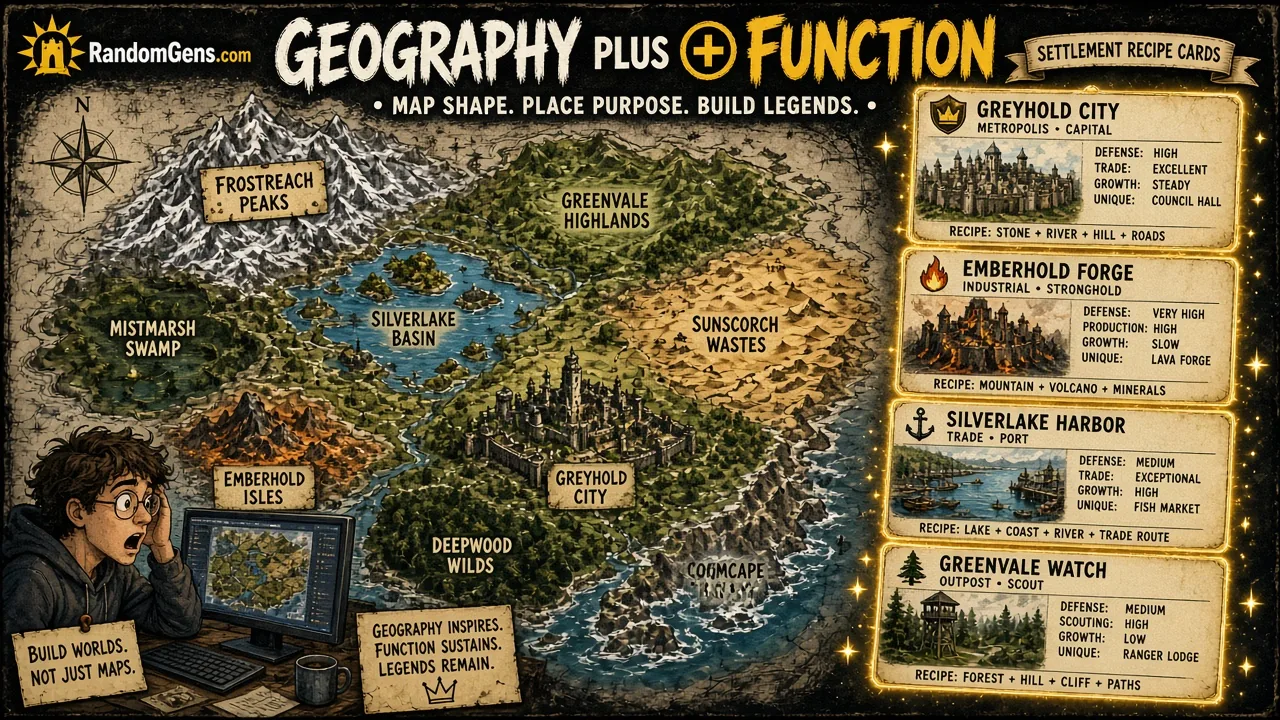
Geography cues (ford, harbor, hill, pass, oasis)
Start with what a traveler would notice:
- Water: ford, falls, delta, spring, marsh
- Height: hill, ridge, pass, cliff, plateau
- Dry or harsh: oasis, salt flat, ash plain, wind gap
- Coast: harbor, spit, sound, reef
Write the cue in plain English first. “Salt gate on the caravan road” is a better seed than “Zyx’quar.”
Function cues (market, fort, temple, mine, crossroads)
Then add why people stayed:
- Trade: market, staple, fair, toll
- Defense: fort, keep, watch, wall
- Faith: temple, shrine, abbey (or your world’s equivalent)
- Industry: mine, kiln, yard, mill
- Travel: crossroads, ferry, waystation
Geography answers “where.” Function answers “why a city, not a campsite.”
Worked example: from “salt + gate” to a believable city name
- Plain seed: salt flats + fortified caravan gate
- Culture palette choice (for this region): hard stops, open vowels, endings in -en / -gate / -hold (not soft -elle cities)
- Draft pile: Saltgate, Saltenhold, Gate of Salts, Salden, Ashen Gate
- Drift pass: locals shorten “Saltenhold” to “Salten”; outsiders still say “Saltgate”
- Scale check: this is a border fortress-city, so “Saltenhold” fits better than “Salten Village”
- Aloud/UI check: fits on a map label; does not collide with nearby “Salden Marsh”
Final on the map: Saltenhold (official), Salten (local short form). Meaning still peeks through. That is the point.
You can run the same recipe for “river + market,” “pass + watch,” or “harbor + temple.” Keep the seed honest before you decorate.
Build a culture sound palette (keep neighbors related)
Shared prefixes, endings, and forbidden letters
For each culture or language family on your map, write a tiny style sheet:
- Preferred openings (Ka-, Tor-, Bel-)
- Preferred endings (-en, -holm, -jar, -th)
- Letters you almost never use in that culture
- Stress pattern (first syllable vs second)
Neighboring towns should feel related. Distant empires can sound different on purpose. Mixing every aesthetic in one river valley is how syllable salad starts.
The Writing Stack Exchange discussion on place names that feel like they belong to a culture keeps returning to the same idea: shared phonetics beat isolated cleverness.
Conquered or ancient layers (borrowed names, eroded forms)
Real cities stack history. A fort name becomes a district name. Invaders mishear a river name and it sticks. FantasyNameCraft-style system thinking helps here: allow older forms, borrowings, and eroded shorts instead of one pristine invented language on every sign.
Practical move: for major cities, write one older form and one modern form. You do not need a full conlang. You need a believable scar.
Name by scale
Capitals vs market towns vs villages
LoreQuest-style scale tables are useful because capitals and hamlets rarely share the same naming swagger.
| Scale | Naming tendency | Example shape |
|---|---|---|
| Capital | Shorter iconic form, older layer, or title-heavy | One strong word; maybe “High X” |
| City | Feature + function still visible | Harbor + staple, ridge + keep |
| Market town | Clear trade or road cue | Ford + market, cross + toll |
| Village | Plain and local | Hill + ham, spring + field |
| Ruin | Memory name, cursed nickname, or old official form | “Old Salten,” “the Broken Gate” |
If every speck on the map is “Grand Eternal Throne of X,” scale collapses.
Castles, ruins, and wilderness labels
Castles can carry builder names or duty names (Watch on the Pass). Ruins often keep an obsolete official name plus a fearful nickname. Wilderness labels can be descriptive longer forms that settlements later shorten. That shortening is drift, and drift sells history.
Drift and nicknames
Official name vs local short form
People shorten what they say daily. “Saint Mary’s Landing on the White River” becomes “Marylanding,” then “Marys.” Put the short form in dialogue and the long form on decrees. Instant texture.
Letting time “sand down” a longer original
Obsidian Tavern and similar city-building notes treat erosion as normal. You can invent the long original, then delete syllables until it is mouth-friendly. The deleted history still informs nearby related names.
Quality tests before you lock the map
Say it aloud three times
If you stumble, players will stumble. If it sounds like a joke you did not intend, rewrite.
Does it fit on a map label / UI?
Tabletop maps, video game HUDs, and Discord travel channels all punish 18-letter stacks. Capitals can be short. Villages can be longer only if they are rare on screen.
Could two nearby cities be confused?
Read the region list fast. If two names share the same opening punch and ending shape, rename one. Confusion is a gameplay bug, not flavor.
Also avoid mocking real sacred names or living community names for cheap exotic points. Invent patterns; do not punch down.
Generate volume only after the rules exist
RandomGens city, country, wizard, and word tools
Method first. Tools second.
- Random city name generator for settlement batches once your palette exists
- Random country generator for realm/region name sparks and bordering polity flavor
- Wizard name generator when a founder, saint-analogue, or mage-line lends a personal name to a district or college town
- Random word generator for raw stems you then bend into your endings
Honest limit: RandomGens will not know your river system, phonology sheet, or faction history. It throws clay. You apply the recipe and throw most results away.
Batch by region, then cut ruthlessly
Generate ten names for one culture pocket. Keep two. Rename three with your endings. Delete the rest. Then move to the next pocket with a different palette. Batching by region prevents the whole continent from sounding like one playlist.
Mini case study (one region, five settlements)
Region concept: windy salt plateau, caravan empire, hard consonants, endings -en / -hold / -gate / -mere.
- Saltenhold – fortified salt-road gate city (from the worked example)
- Torrmere – shallow seasonal lake town; “mere” kept as water cue; locals say “Torre”
- Belgate – secondary toll gate; related to Saltenhold’s -gate family without cloning it
- Ashenfield – village on the black-soil edge; plainer scale on purpose
- Old Karen – ruin of a pre-empire shrine town; short, older vowel feel; travelers use it as a landmark warning
Country-level label for the polity might come from a country-generator spark, then get filed to match the palette (not left as a random modern Earth name unless that is your world’s joke). A wizard-founder district inside Saltenhold could borrow a wizard-generator personal name, then take a local ending: “Vael’s Hold” drifting to “Vaelhold.”
Five names. One culture. Readable hierarchy. That beats fifty unrelated syllables.
Anti-patterns that make maps feel fake
Watch for these failure modes when you revise:
- Same grandeur everywhere: every village is “Eternal,” “Supreme,” or “Undying”
- Apostrophe cosplay: stacks of consonants with punctuation that nobody can say
- One generator playlist: coastal, mountain, and desert cultures share identical endings
- No short forms: every official name is also the casual name, so the world feels newly printed
- Meaningless collisions: two capitals that differ by one vowel on the same trade road
When a draft region fails those checks, return to the feature + function seed. Decoration is cheap. Structure is not.
Also remember RandomGens honest limits here: the city generator can flood you with options, but it will not enforce your palette, scale table, or drift rules. Keep a sticky note with endings and forbidden letters next to the browser. Cut ruthlessly after each batch.
Sources and further reading
- Wikipedia: Place name origins
- LoreQuest: How to name fantasy places
- Runenym: Fantasy kingdom naming
- FantasyNameCraft: City naming systems for fantasy maps
- Writing Stack Exchange: Culture-consistent place names
- Obsidian Tavern: Building a fantasy city
Optional real-world color on how cities get names: The Guardian on how cities get names.
This is creative method help for fiction and games, not academic linguistics advice. For RandomGens tool help: support@randomgens.com.